Depending on the need and budget of the users the type of the FAS is selected and installed.

080-25593891
09.30 AM - 6.30 PM

A Fire alarm system is a combination of a interlinked electric /electronic devices integrated to detect and alert on any incident of fire /smoke immediately on occurrence so that the measures for extinguishing the fire is taken at the earliest possible time to prevent loss of human life / material loss.
Fire alarm systems are mainly of 2 major types namely the conventional and the addressable systems. Some of the major differences are given below for better understanding of the 2 types of FAS.
Depending on the need and budget of the users the type of the FAS is selected and installed.
| Parameter | Conventional Systems | Addressable Systems |
|---|---|---|
| Detectors Identification | Detectors are identified zone wise | Each and every individual detectors/devices have a unique address defined and the faults can be traced easily |
| Alarm Threshold | Alarm threshold levels setting for individual detectors not possible | Different alarm threshold levels can be set individually for each detector depending on the area of use |
| Pre Alarm Warning | Pre alarm warning not available | Pre alarm warning available which allows to know the problems in advance and helps to take necessary action |
| Wiring | Wired as separate circuit zone wise | Can be wired in loops |
| Event Log | Basically not in-built | System events are recorded in event log to take reports as per the requirement. |
| Programming | Simple Programming | Advanced programming options for programming the systems as per the user needs |
| Configuration | Easy to configure zoned FAS | Complicated to set up |
Control Panel:
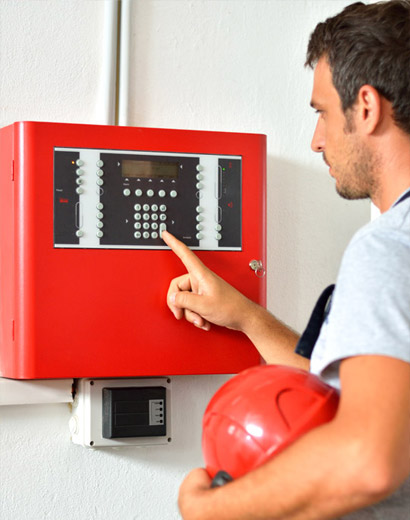
An FAS main and core component is the Control panel which continuously monitors the signals inputs from various initiators /detectors integrated in the system and controls outputs and relays information as per the configuration done in the system. Depending on the type of the FAS selected the features / configuration options available / capacity of the control panel differs. So the exact requirement of the complete FAS should be taken into consideration before product selection.
An FAS in general consists of the following :
– Contains programming and operating electronics and user interfaces
– Fed by standard branch-circuit wiring and contains replaceable circuit cards – zonewise
– An alphanumeric display showing the state of the system and providing troubleshooting information
– A touchpad for silencing an alarm or trouble signal, resetting the system following an event and reprogramming,
The initiators are also one of the most critical components of FAS as these are the devices which give the necessary input signals to the fire alarm based on which the control panel monitors the whole system.
The initiators can be actuated either manually or automatically depending on the requirement on the particular area /location of the site.
Manually actuated initiators – Manual pull stations, Break glass stations, call points / Buttons.
Automatically actuated initiators – Smoke Detectors, Gas leakage detectors, heat detectors etc.
The FAS notifies /generates alerts based on the inputs from the initiators and the configuration of the control panel. The device used to perform this action of notification is done by the Indicating /notifying appliances. This act as an output to the FAS control panel and has the main function as listed below
-Announce to building occupants or a remote location when the system enters alarm state
– Appliance types include hooters, strobe lights chimes, bells, or a combination of all as per the requirement.
– Available in weatherproof and hazardous location versions.
Intrusion Alarm systems are systems designed to detect the presence of intruders at your premises, trigger a local siren to deter activity and simultaneously, communicate the event to a security monitoring centre so that an appropriate response can be coordinated. In today’s scenario these systems have become very much essential. An intrusion alarm system that meets all the above criteria can only be achieved by installing a combination of detection devices throughout the premises.
Key points of consideration while selecting a IAS system:
Advantages of IAS:
An IAS control panel is the main core component of the IAS as it integrates multiple detection and alarming devices and is configurable as per the requirement of the users and location/site installed. With a control panel, you can instantly pinpoint the location of an entrance even at a comparatively large infrastructure.
Features / Spec:Magnetic contact switches
A Magnetic contact switches or a ‘reed switch’ is the technology to an accurately determine the opening and closing of a door. A magnetic switch consist of a switch and magnet, with the magnet commonly installed at the door. When the magnet is within a specific distance, the switch turns ‘ON’, signaling a closed door. When the magnet moves beyond the specific gap, the switch turn ‘OFF’, for the open door.
Motion /PIR detectors
A Motion /PIR detector captures and indicates the passive infra red radiation emitted by objects at its field of view. As it has no active IR LED’s, it acts through capturing the emitted infrared from its field of view.
Glass Break Detectors
The modern tamper-proof glass break protection alarms cover the glass covered windows or door portion of your building that are the most vulnerable points for an intrusion. When the glasses are breached or broken, it gives out an instant alarm even when the breaking produces no noise.
Panic Switches
This is a simple switch which is normally kept in easily accessible but hidden manner for the people to press in case on any intrusion /burglary attempted during the normal working hours when all the automatic sensor zones are kept disabled as per the configuration of the panel
A Signaling device is nothing but a device which raises an alarm which can be a sound or visual alarm depending on the signaling device based on the trigger from the control panel. These devices are normally connected through the control panel. These devices are configured and positioned in the right places so that people can be aware of the the intrusion easily and take corrective measures. Example of signaling devices are Hooters , Strobe lights etc.